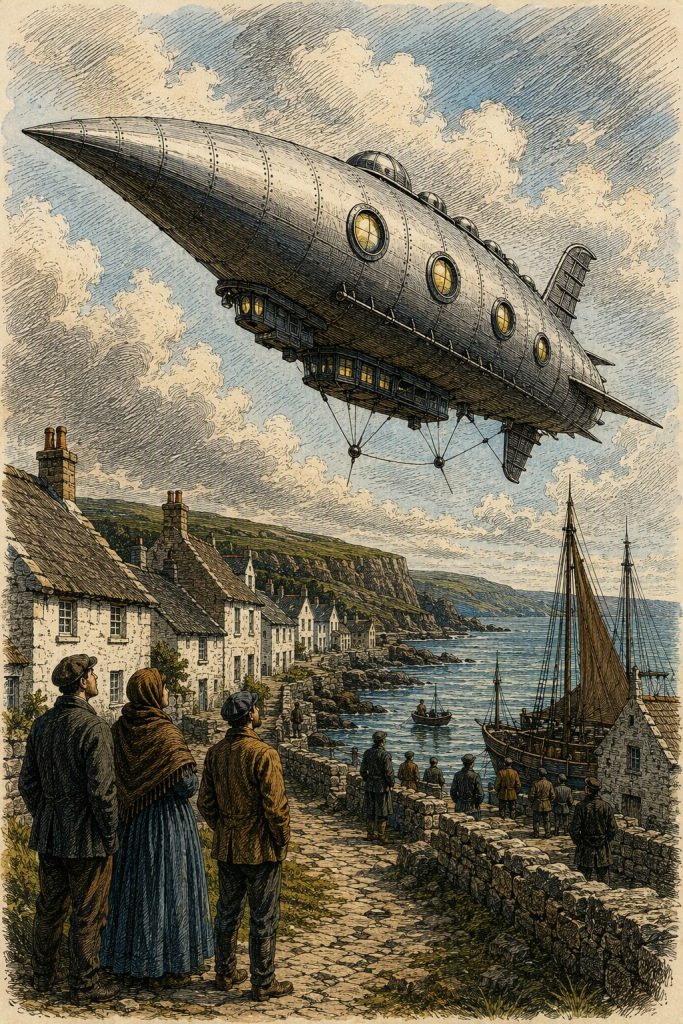
History tells us that in the first half of 1910 there were just two types of people on Earth: those who were excited about the return of Halley’s comet; and those who thought it was going to bring about the end of the world.
According to Robert E Bartholomew and Hilary Evans, in their book Panic Attacks: Media Manipulation and Mass Delusion, the trigger for this fear was an article in the New York Times on 7 February 1910. Astronomers had already calculated that Earth was due to pass through the tail of the comet on 18 May 1910, and in the New York Times article it was reported that astronomers at the University of Chicago’s Yerkes Observatory had identified that the comet contained deadly cyanogen.
“The fact that cyanogen is present in the comet has been communicated to Camille Flammarion and many other astronomers, and is causing much discussion as to the possible effect on the earth should it pass through the comet’s tail. Prof Flammarion is of the opinion that the cyanogen gas would impregnate the atmosphere and possibly snuff out all life on the planet.”
Camille Flammarion was an astronomer of the highest repute. In 1897 he’d been awarded the Prix Jules Janssen, the highest award of the French astronomical society. His opinion mattered. And his opinion was being reported in the newspaper regarded as the USA’s leading newspaper of record – in other words, what it reported could be trusted.
The public began to panic.
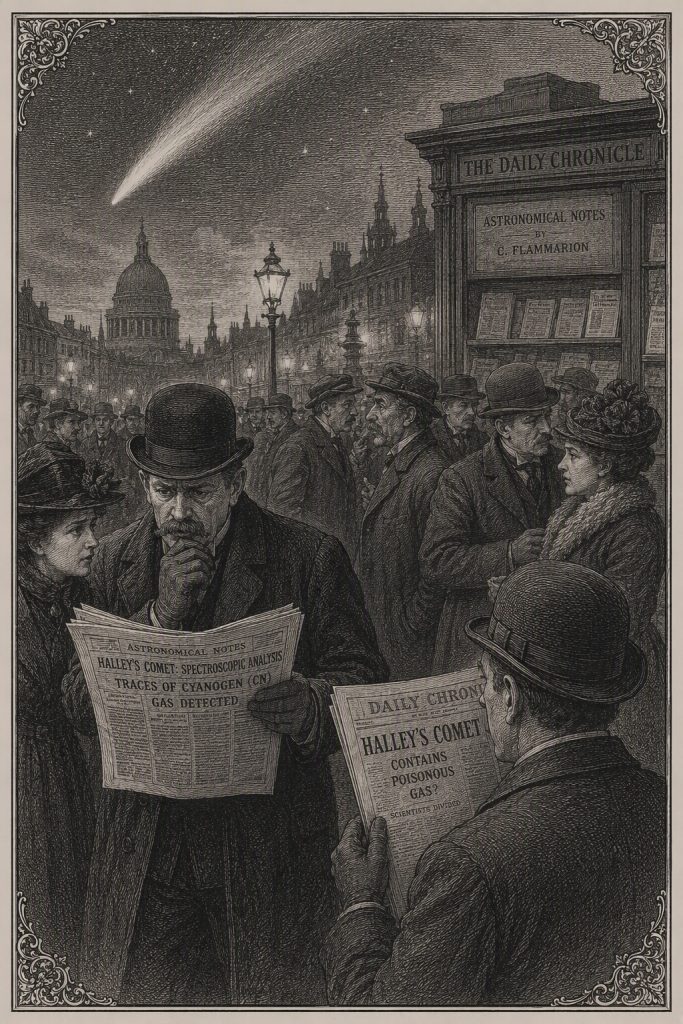
Two days later, in an effort to correct this, the New York Times published another article. In this piece, titled “No Danger from Comet”, University of Michigan astronomer William J Hussey completely rubbished the idea of Halley’s Comet causing mass poisoning. The Times followed this with an editorial that confidently stated that the Earth could pass through a dozen comet tails without any ill effects.
But the genie had no intention of going back into the bottle. The panic continued. And the countdown to the “night of doom” – when the Earth would pass through the tail of the comet – began.
While the New York Times may have been responsible for starting the panic, others helped it build momentum. The Washington Post, for example, ran an article in which a number of astronomers strongly disputed this prediction of mass poisoning. However, the article concluded: “On the other hand, it is pointed out that the spectroscope has shown that there is a large quantity of cyanogen gas in the atmosphere surrounding Halley’s Comet, and some chemists, such as M. Dastre, say that being practically without odor, the presence of the gas would not easily be perceived. A mixture of this gas with air would lead to certain poisoning.”
By the beginning of May 1910, panic had evolved into hysteria – not just in the USA, but in Russia, Japan, Mexico and Italy, and many other places besides.
But right in the middle of this hysteria, in a small fishing village in County Donegal, something incredibly strange happened.
II
On the evening of 6 May 1910, on Doagh Island, a small peninsula on the Inishowen Peninsula in County Donegal, the men were working in the fields.
Some time between 6 and 7pm, their attention was drawn to what they believed was a large steamship coming in from the North Atlantic. It was shrouded in a dense blue-grey vapour which rose high into the sky. And it was heading at great speed for the mainland.
Fearing that the ship was about to crash, the men threw down their tools and ran to where they believed it was heading.
When the men got within 400 yards of the vessel, they could see that it was no ordinary ship. Even its “cloak of cloud” couldn’t hide its strangeness. But what happened next was completely unexpected. Instead of crashing, the ship rose out of the sea and began “sailing” over the land.
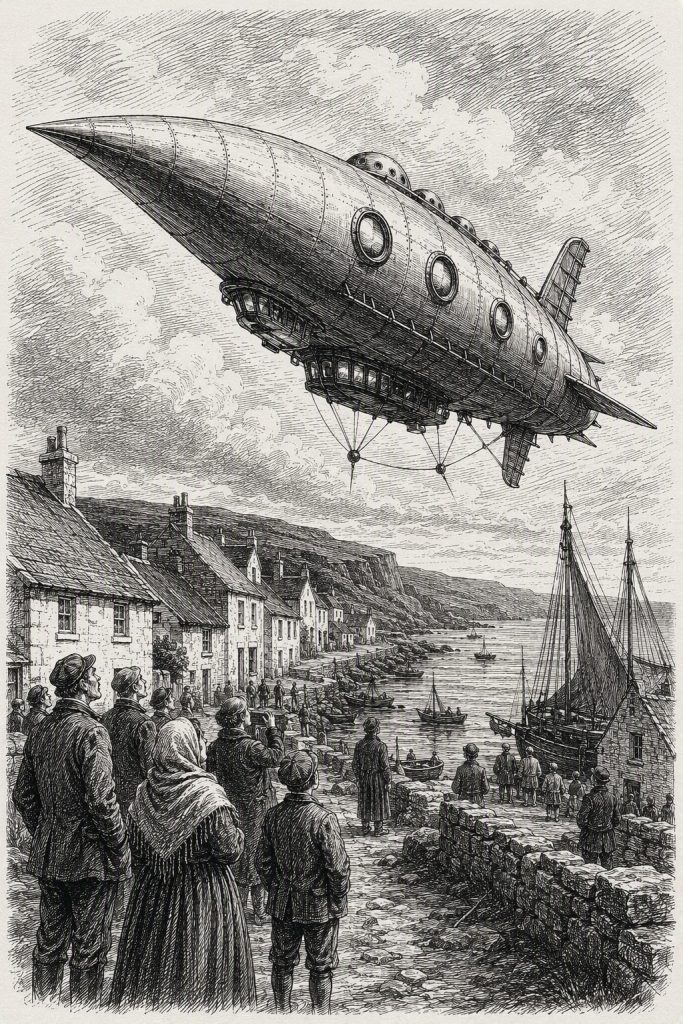
Making landfall just south of Carrickabraghy Castle, the strange ship headed for Lagacurry village. It moved with a strange “undulating motion”. Witnesses said it was “sometimes rising high above the sea level, and again descending within a few feet of the surface of the soil.”
The ship passed directly over the village, making a deafening noise that had the people running out of their homes. The general consensus was that the noise resembled that made by a huge waterfall.
Shortly after the ship passed over Lagacurry, a “sharp explosion” was heard, followed immediately by a dull thud – as if something had fallen from the ship. Later it was discovered that a mudbank “had been furrowed as if with a gigantic plough” – and three row-boats were found to have been smashed.
The ship continued its journey, heading for Malin, four miles from Lagacurry. Along the way it passed over some fields. In one of these fields, some cattle were later found to have been injured. And in another, crops had been destroyed.
The ship passed directly over Malin village. As in Lagacurry, the horrendous noise of the thing brought people out of their homes. In Malin, they described the noise of the ship as being like a “violent hailstorm.”
After Malin, the ship headed for Culdaff Bay – and back out to sea again.
III
According to The Irish News of 11 May, when reports of the Doagh Island incident were first received, they were deemed to be so remarkable that no one believed them. “However, investigations made in the areas affected place beyond doubt that there has been a happening of a most uncommon, not to say uncanny, character.”
So, journalists were able to establish that the area had indeed had an “extraordinary visitation”. But what was the nature of this strange visitor?
The coastguards – who had received reports of the incident – believed that the ship was nothing more than “one of the great dirigibles” that had been lost some time before in the North Sea. And that an anchor trailing from one of these airships would account for the damage done on the ground. They made no effort to explain the incredible noise made by the machine, its “cloak of cloud” or how the engines on an airship were still running after several weeks.
Not that the locals paid much heed to the coastguards’ theory.
According to The Irish News: “The fishing population, however, speak of the visitation as being of quite an unearthly description, and pray they may be spared a recurrence of it.”
Many believed that the machine was somehow connected to Halley’s Comet, and feared it was a harbinger of some kind – a messenger of catastrophe.
Events in London later that same evening seemed to confirm those fears.
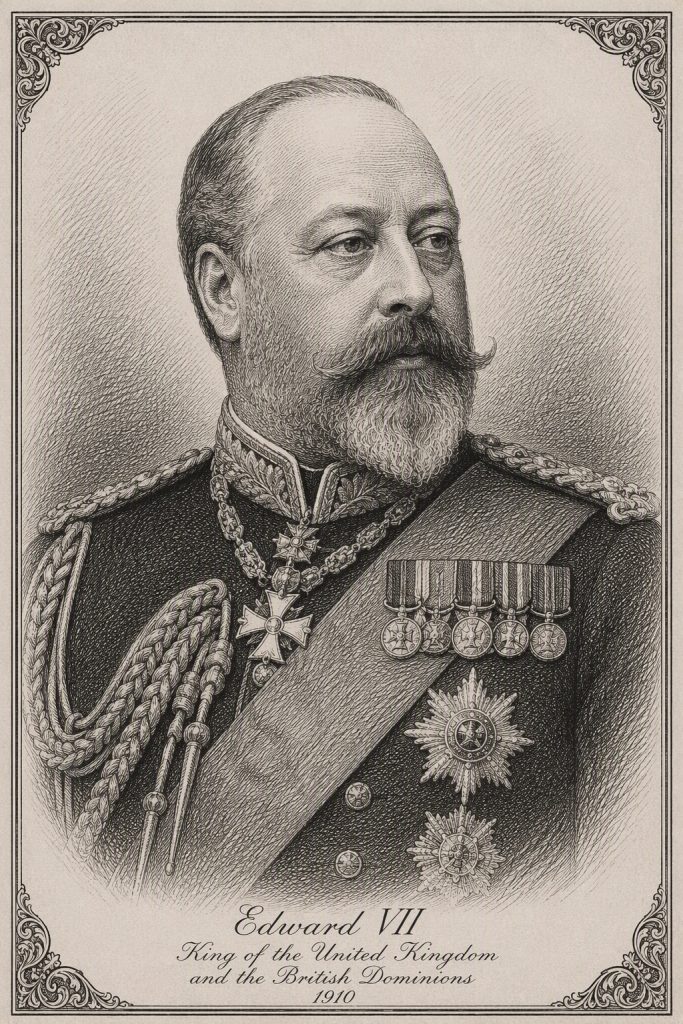
Unbeknownst to the public, Edward VII, King of the United Kingdom of Great Britain and Ireland and of the British Dominions, had been seriously ill for some months. And on 6 May, he suffered a number of heart attacks.
Choosing to remain at Buckingham Palace, the king drifted in and out of consciousness throughout the day. That evening, during a brief period of consciousness, Edward’s son – the Prince of Wales and soon-to-be King George V – informed him that his horse, Witch of the Air, had won at Kempton Park that afternoon.
“I have heard of it,” he said. “I am very glad.”
Those were the king’s last words. At 11:30pm, Edward VII lost consciousness for the last time. Fifteen minutes later, he was dead.
When news of the king’s death reached Doagh Island, it confirmed what many had feared. The machine really had been a harbinger.
But was this just an overture? The opening piece of a larger catastrophe?
Had the comet come to end all life?
IV
Twelve days after the events in Donegal, Earth was due to pass through the tail of Halley’s Comet on the night of 18 May – the “night of doom”.
In many parts of the world, people came together to spend the night in prayer. And either those prayers were answered – or there was no need for them in the first place. Either way, there was no mass poisoning. On 19 May 1910, those who hadn’t spent the night in prayer woke up, got out of bed and got on with their day.
Admittedly, the comet scare didn’t end immediately. It would be some weeks before people in all corners of the planet realised the comet wasn’t going to kill them. But people gradually got back to their normal lives.
Prayers were answered in Donegal, too: their extraordinary visitor never returned. Exactly what it was or where it came from has never been uncovered.
Unless otherwise attributed, all images were created by the author using Microsoft Copilot (AI)
Really enjoy your work and looking forward to the next