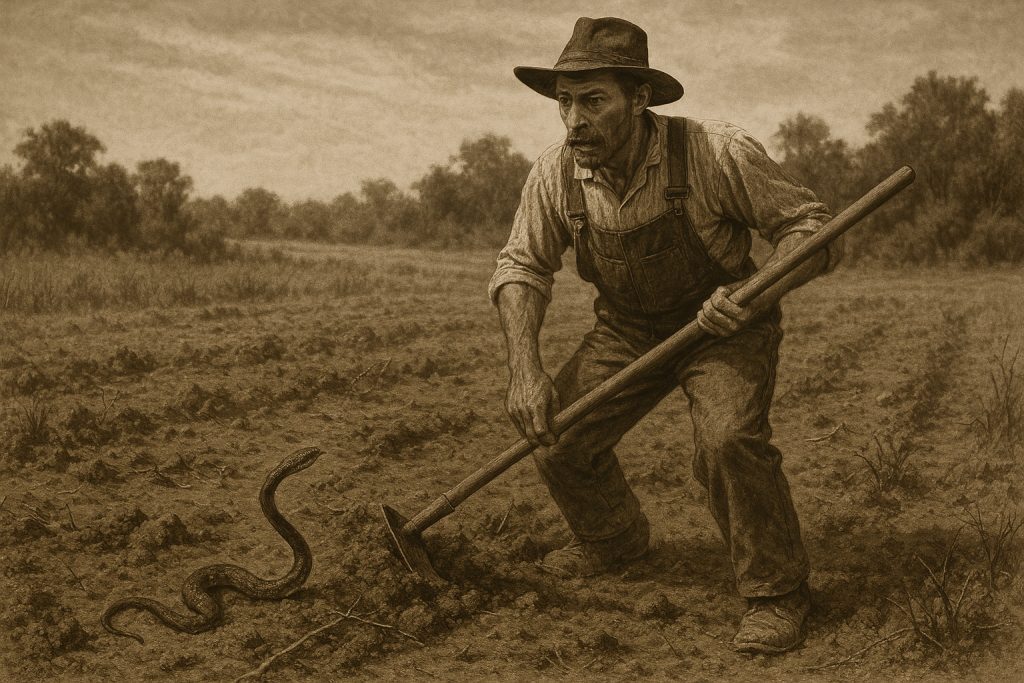
ON 27 MAY 1912, in Sparta, North Carolina, Sam Brown was working in one of his fields when he encountered a snake. “It scared me, and I jumped back a step or two. It was a striped pilot, and a large one, too,” he told reporters at the time.
Sam recovered his composure – and walked back to the snake with the intention of killing it. “Just as I got within about two steps of it, I caught its eye or it caught mine, I don’t know which. I had just reached up to scratch my face. My hand and arm stuck in the air. I couldn’t move a muscle – could do nothing but stare at the snake.
“Everything turned bright blue around me. I seemed to be enveloped in a sort of haze.”
Perhaps Sam was frozen with extreme fear. But what happened next suggests he was under some kind of influence.
“Instantly I felt some inward or outward force, I don’t know which, impelling me toward the snake. I was conscious at the time that its bite was certain death, but hold back or take my eyes off that snake I could not.”
The snake, with eyes that “seemed to burn with fire”, drew Sam closer.
“Nearer and nearer I came to it, and just that much nearer I knew my end to be. Every muscle was tense, but there was not a muscle I could move voluntarily, not even my tongue.”
Soon, Sam was standing over the snake – feeling absolutely helpless. And just when he believed the snake was about to strike, one of his farm hands approached and distracted it – breaking the “spell.”
Sam was left in quite a state following his encounter: sleeping for days and becoming “alarmingly weak and helpless.”
2
Snakes have been around for millions of years – and in that time they have evolved some incredible abilities.
For example, some snakes can detect infrared heat – allowing them to hunt warmblooded prey in the dark. Others – thanks to a slow metabolism – can go months at a time without eating. And then there’s the hognose snake.
The hognose snake, when spooked by a predator, will play dead. It will flip over, let its tongue hang out, and give off a foul smell to not only convince the predator that it’s dead – but that it’s been dead for some time.
It’s quite a trick. But have some snakes really evolved the power of hypnosis?
Science says “No!” That it’s just another of the many myths associated with snakes. For example, it was long believed that snakes were vengeful; that if you killed a snake another would come after you. And in some parts of the world, it was believed that a snake couldn’t bite you if you were pregnant or wearing an emerald.
And possibly the most enduring snake myth of them all: that Saint Patrick banished them from Ireland.
However, throughout the 1800s and early 1900s, newspapers carried incredible tales that reinforced the belief that some snakes could indeed mesmerise their prey – including humans.
The Andy Austin case was particularly convincing.
On 29 November 1888, 16-year-old Andy Austin was hypnotised by a rattle snake that was on display in the window of Smith’s Gun Shop in Bridgepoint, Connecticut.
Andy had been standing for an hour with his face pressed against the shop window – terrified and powerless to move – before anyone realised he was in distress.
“His face seemed glued to the window glass,” reported The Evening World. “He was noticed from inside the store by the glassy stare of his eyes, which seemed bursting from their sockets. His nose was flattened and his mouth firmly set against the glass.
“The snake had coiled himself, raised his head and charmed the boy. Only the intervening glass plates saved the boy from being struck by the reptile’s fangs.”
Eventually, Andy was taken away from the window. He was incredibly shaken – both physically and mentally – by the experience. So much so that when one newspaper followed up on the story one month later, they discovered that Andy still hadn’t recovered and had been taken to a hospital in Virginia for treatment.
But what if – glass or no glass – he’d never really been in any danger? What if the snake had never wanted to harm Andy. What if the snake had just been trying to connect with him?
3
In September 1875, in the Blue Mountains, Pennsylvania, 11-year-old Eagle Rogers began a routine of leaving his home each morning at 9 o’clock – and returning again at noon. Whenever his parents asked him where he was going, Eagle always gave the same answer: he was going to play with a boy named Springer.
When Eagle left the house at his usual time on Friday, 1 October 1875, his father, Allen, followed him. About half a mile from the house, he saw Eagle make his way through some undergrowth and take a seat on a large rock.
After about 10 minutes, a “huge black snake” appeared. This was the largest snake Allen Rogers had ever seen in the hills. It was fifteen feet long and its body was as thick as his arm.
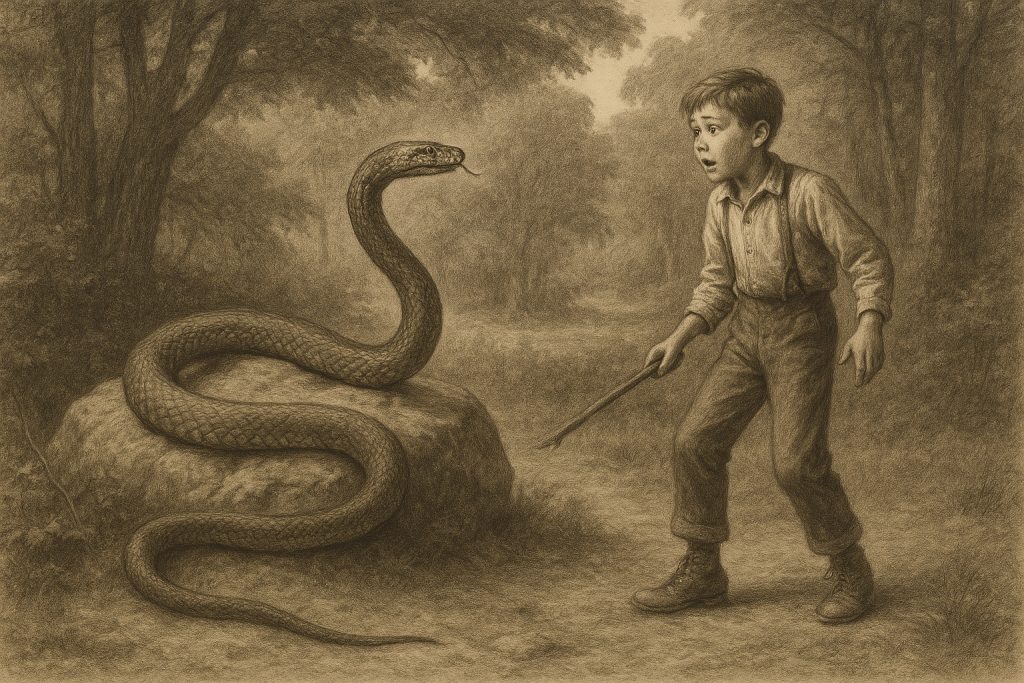
To his horror, the snake crawled up on the rock and put its head on his son’s lap.
Eagle had brought food with him – and he began to feed the snake. And once it had been fed, the snake coiled itself around Eagle’s body – and appeared to play with him.
Allen was horrified, and his first instinct was to wrestle the snake away from his son. However, he had heard stories of other children being charmed in this way by snakes; and according to these stories, if the snake was disturbed it would kill the child.
Reluctantly, Allen left his son with the snake and made his way home.
When Eagle returned home at noon, his father told him what he had seen.
Eagle explained that on the first day he met the snake, he played with it and gave it some of his food. He enjoyed his time with the snake. But something told him that he must meet the snake every morning.
And so began his strange, morning routine.
On Saturday, 2 October, Allen Rogers and two of his neighbours returned to the rock and waited. And when the snake appeared – they shot it dead.
4
There are many stories similar to this from the 1800s. Sometimes they involve a girl instead of a boy. But each story follows a similar pattern: a child is charmed by a snake; parent finds out; parent kills snake. And each story hints at some sort of psychic link – between the snake and the child – that connects them even when they are physically apart.
But what sets some of the stories apart is the age of the child involved.
In August 1906, in Noblesville, Indiana, Mrs William Davis noticed that her two-year-old daughter would go off on her own at the same time every day. And after a few days of this, Mrs Davis decided to follow her daughter to see what she was up to.
The child went off at her normal time – and crawled up the stairs. A few minutes later, Mrs Davis crept up the stairs after her.
At the top of the stairs – to her horror – she found a 7 foot snake coiled around her daughter, who was stroking the snake and “laughing and cooing over it.”
Mrs Davis immediately snatched the girl away – then “trampled the intruder to death.”
That same summer, in Vincennes, Indiana, a two-year-old boy was “charmed” by a snake while he was in the garden with his mother.
Mrs Wolfs was in her garden picking beans while her son, Earl, was playing nearby. Earl began to cry – but soon stopped. So Mrs Wolfs carried on picking beans.
When she was done, she turned to her son. She found him “standing like a statue” in the same spot where he had been crying earlier. Mrs Wolfs called to him – but he didn’t respond.
When she went to her son, she saw that a snake had wrapped itself around both of his arms, and was moving its head rhythmically, to and fro.
Earl’s eyes were locked on the snake’s eyes.
With a stick, Mrs Wolfs uncoiled the snake from her son, which seemed to break the spell – and Earl began to cry.
5
This is a small sample of newspaper stories involving snakes with the power to hypnotise. There are many, many others.
But is there any truth behind these stories?
To help answer that, we need to look at one of the most infamous tabloid stories of the 1800s.
In August 1835, a New York newspaper published a series of articles about a fantastic discovery made by British astronomer Sir John Herschel.
Using the “world’s strongest telescope,” Herschel had discovered life on the moon. Not evidence suggestive of life – or evidence that life may have existed there in the distant past. And not microbial life – that would be debated about for the next few decades. Actual life.
According to the newspaper’s accounts, Herschel could see actual living creatures at the other end of his telescope. There were creatures that resemble bison, bears and elk; and there were all manner of birds flying across the lunar sky. But it was the human-like creatures with bat-like wings that really captured the public’s imagination.
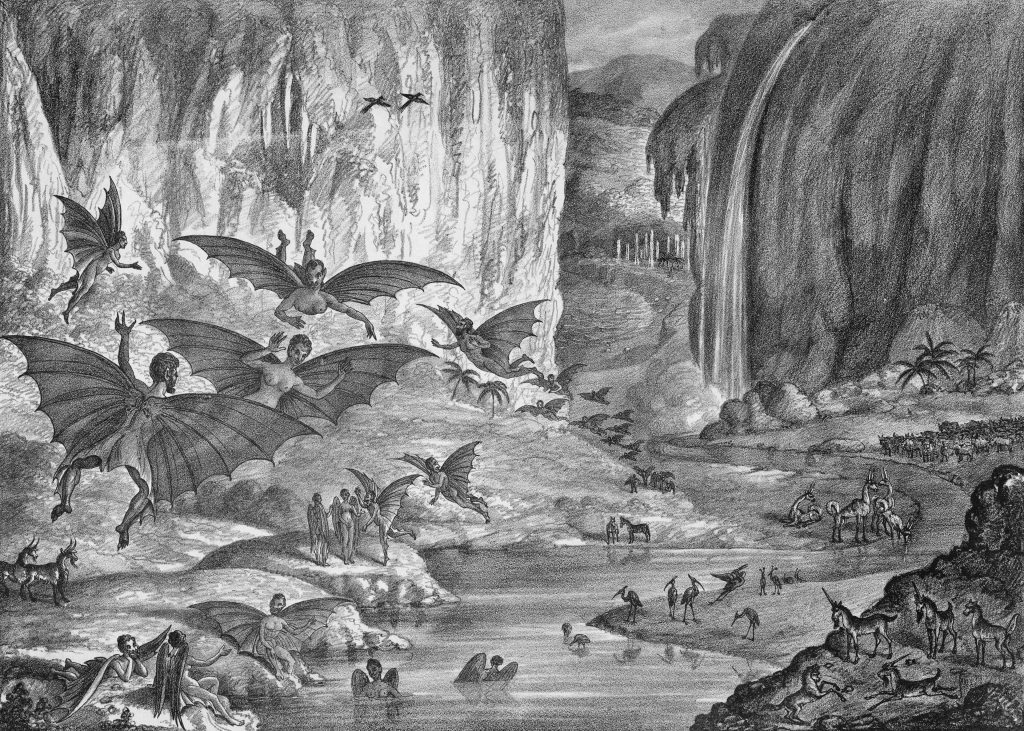
The stories appeared in The Sun. Launched in 1833, The Sun was the first successful tabloid newspaper. It was priced at only 1 cent (the average price of a newspaper at the time was about 6 cents) to make it affordable to the masses, and it focused primarily on sensational stories that would appeal to the masses.
It was already a huge commercial success by 1835, but the moon stories took its sales to a whole other level. The public – including more than a few scientists – couldn’t get enough of Herschel’s fantastic discovery.
Needless to say, the moon stories were complete fiction, written by a reporter called Richard Adams Locke.
Fake news is not a creation of 21st Century. It’s been around for some time – long before AI and social media. And while our big fear in the 21st Century is that fake news is being used to influence our beliefs and our behaviour – more often than not, fake news was just about selling newspapers.
And stories about Bat-men on the moon and hypnotic snakes in Pennsylvania sell newspapers.
So, were the hypnotic snake stories just fictional accounts – by writers like Richard Adams Locke – designed to sell newspapers?
Probably.
But the world is a strange place. If your child suddenly starts putting together picnic hampers and heading off at the same time every day to meet a friend you’ve never heard of, you might want to follow them – just in case.
IOW
Recommended Reading
If you enjoyed this post and would like to know more, you might enjoy the following book:
Snakes of the World: A Guide to Every Family – by Mark O’Shea
If you’d like some actual facts about snakes, this is a great place to start. Informative and beautifully illustrated.
Snakes of the World: A Guide to Every Family can be found wherever you normally buy or borrow books. It’s also available on Amazon – and if you use this link, as an Amazon Associate I will receive a small commission.
Brilliant insight to the journalism of past times. Love the one about the boy feeding the snake
Thank youfor your kind comments! Always appreciated!